
🎯 Goal: Help organizations move beyond checkbox controls by integrating real-world threat modeling into their cloud security decisions.
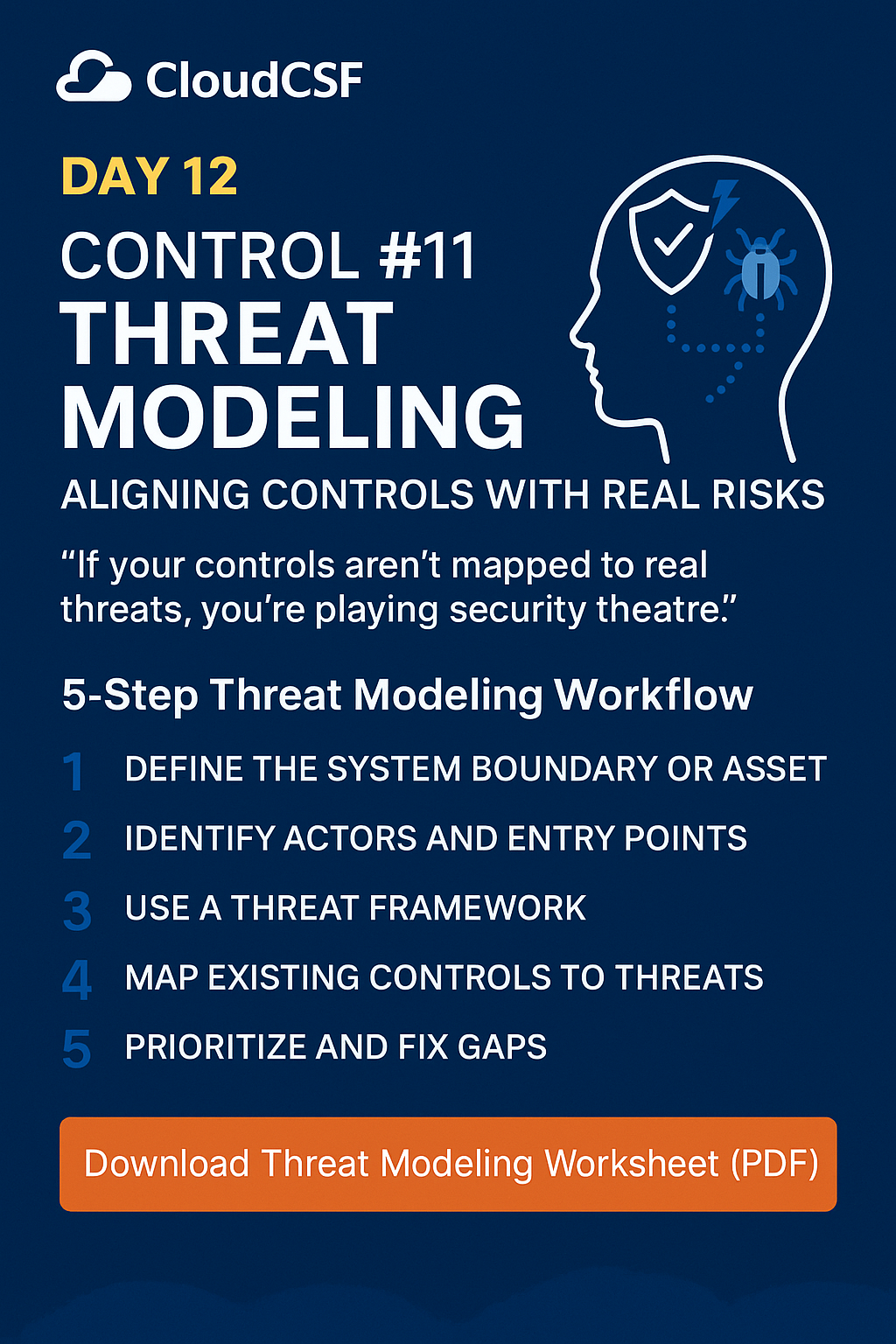
🧠 CloudCSF Day 12
Control #11: Threat Modeling – Aligning Controls with Real Risks
“If your controls aren’t mapped to real threats, you’re playing security theatre.”
⚠️ The Gap Between Controls and Reality
Many organizations proudly show off their compliance dashboards…
✅ ISO 27001 done
✅ SOC 2 done
✅ NIST checklist complete
Yet in a breach?
They had:
- No alerting for critical misuse scenarios
- No compensating control for exposed APIs
- No visibility on lateral movement
👉 Why? Because controls were applied generically — not based on real threats to their business model.
🔍 What Is Threat Modeling?
Threat modeling is the process of:
- Identifying what could go wrong
- Mapping it to real-world attack techniques
- Prioritizing risks based on impact, exploitability, and business relevance
- Aligning security controls to actual threats, not theoretical ones
✅ 5-Step CloudCSF Threat Modeling Workflow
- Define the System Boundary or Asset
- e.g., customer-facing app, billing API, admin console
- Identify Actors and Entry Points
- Internal user, 3rd party, threat actor, insider
- Where do they interact with the system?
- Use a Threat Framework
- STRIDE, MITRE ATT&CK Cloud, OWASP Top 10
- Identify what could go wrong (spoofing, privilege escalation, etc.)
- Map Existing Controls to Threats
- MFA, logging, WAF, token validation, rate limits, etc.
- Are they sufficient? Are they bypassable?
- Prioritize and Fix Gaps
- Use a matrix: Likelihood vs. Impact
- Implement targeted mitigations, not blanket policies
📊 Threat Modeling Maturity Levels
| Level | Description |
|---|---|
| 🚫 0 – None | No threat modeling practiced |
| ⚠️ 1 – Ad Hoc | Done only during audits or incidents |
| 🔁 2 – Periodic | Run at start of projects or systems |
| 🔐 3 – Continuous | Embedded into DevOps and design reviews |
| 🛡️ 4 – Automated + Risk-Aligned Controls | Dynamic threat modeling + auto mitigation suggestion |
🛠️ Tools You Can Use
- ✅ Microsoft Threat Modeling Tool
- ✅ OWASP Threat Dragon, IriusRisk
- ✅ MITRE ATT&CK Navigator
- ✅ Lucidchart, Draw.io (for diagramming threat flow)
- ✅ Checklists: STRIDE, DREAD, OWASP Cloud-Native App Security
💡 CloudCSF Pro Tip
“Every security decision should answer this: Which threat does this control actually stop?”
🎁 Free Resource
👉 [Download: Threat Modeling Template & Worksheet (PDF)]
👉 Join the CloudCSF WhatsApp Group for daily control testing intelligence
💬 Comment :
When was the last time your team modeled threats before implementing a control?
Comment “ModelThis 🧠” to get the Threat Modeling Toolkit.
🔁 Coming Tomorrow:
Day 13: Control #12 – Endpoint Hardening in Hybrid Environments
Learn how to reduce your attack surface where cloud meets device.